Showing posts with label seizures. Show all posts

Monday, May 28, 2012

Welcome Home Tigger!

It finally came – the day we have been working towards, preparing for, and eagerly awaiting – May 27th; the day we got to meet Tigger and bring him home with us! Though I admit to having a slight case of nerves (My first dog! And not just any dog, a very special service dog I am going to help train! Eep!), our anticipation was well rewarded with an amazing homecoming. Below, see how our first day with Tigger unfolded -- in pictures!

Tigger's trainer, Kim from Noelle's Dogs Four Hope, requested that we meet her at a mall near her home in PA. She wanted to meet in a public place so she could not only introduce us to Tigger, but could begin to train us on the public access training commands we will be working on while we have Tigger for the next 6 months (after which time he returns to Kim for 3 final months of specialty seizure response training). Though Simon was a little hesitant at first, with some encouragement he pat Tigger's head. Tigger is very gentle and sat quite still as he met his boy for the first time.

Over the next 2 hours we walked around the mall practicing commands and getting to know our new family member. Though I could tell Tigger wasn't quite sure who to listen to (I held the leash and the treats but he still looked to Kim for commands), I was impressed by how well-behaved this seven-month-old puppy was in a relatively populated public setting. The only time he balked was at the elevator (he doesn't like elevators -- something we have to work on with him), and when it was time for him to part from his trainer. I know it was hard for Kim to leave him, too -- how could you not fall in love with this face?


Pretty soon we were on our own -- a newly minted service dog family. 

Everyone took a nap on the way home. It had been a very busy afternoon for kids and puppies (and parents!).

When we came home we discovered our house had been decorated! Our amazing neighbors, the Beckers, had created a very warm welcome. I teared up (as usual) reading the note on the door: "Dear Tiggger, We want to welcome you to our neighborhood! You could not of asked for a better family then the Hatcher's! You will love Simon and adore Olivia, we do! Love, The Beckers"

Tigger was eager to explore his new surroundings and (much to our surprise) Simon wanted to help. I think Simon understands how it feels to want to explore a new place, and so he took Tigger's leash for his very first walk around the house. Simon let Tigger lead, which was very polite of him.

Dinner time! We've been told to try to get Simon to do as much of the care-taking as possible, so Tigger will understand that Simon is "his" boy. In fact, one of the main things we will be working on over the next several months is creating a bond between Simon and Tigger.
Tigger was very interested in Simon's bath. Simon told Tigger he was too big to join him in the tub and should come back later.

Time for bed. We had been nervous about this -- we didn't know whether Simon would be okay with the dog in his room, or if Tigger would be alright being left with Simon. But, one of the main reasons we got Tigger was to help us respond to Simon's nocturnal seizures, and for him to do that he needs to be with Simon when he sleeps. "Start out as you mean to go on" are words I have lived by since the days of babyhood and Tigger's trainer agreed. Put them in the room together and shut the door was what she suggested and (after talking to Simon about it and having him say it was okay, another surprise), that was what we did.
As soon as we left the "boys" alone together, Brian and I turned on the video monitor to watch what happened. We were pretty anxious, especially since Tigger started to whine almost as soon as we shut the door, and Simon pulled his covers over his head. However, after just a little while, a day that had already been special became spectacular.

As Tigger cried, Simon told him to "shh!", but gradually he started to talk to Tigger. And he talked to Tigger for over an hour -- IN ARTICULATE, ORIGINAL SENTENCES THAT DEMONSTRATED EMPATHY.

Here is a sample from a video we took (as soon as we recovered from our shock enough to realize we should be recording this momentous occasion!)

"I'm sorry Tigger. It's okay. You're trapped. Be quiet. Time to go to sleep. Let's take a nap." Then, when Tigger hopped onto Simon's rather small toddler bed: "Tigger, you're too big. You sleep on your bed (pointing) over there. Time to go to sleep." Tigger didn't budge. Simon sat, thinking for a moment, and then he finally decided to give Tigger his nightlight and lay down with him. (I can't overstate how shocked we were!). Finally, Simon sang a song to Tigger that he sings to himself when he is scared at the doctor's. Within a few more minutes, they were both asleep. 

Now, I had heard about service dogs being used to encourage language and empathy in kids with autism. I'd heard that kids who were otherwise inarticulate and friendless were able to gain both language skills and a bond of love when paired with the right animal. I honestly never really believed it. Though I hoped that Simon would find a friendship of sorts with Tigger, I have been so completely focused on Tigger's potential to protect Simon during one of his dangerous status seizures that I really considered anything additional a pleasant but unlikely and less necessary bonus.

I LOVE BEING WRONG.

Today, we took Tigger and Simon out for the first time on our own to buy a bed big enough for the two of them.

Saturday, March 31, 2012

Arts in Action

One of my very favorite essays on design is called "How Good is Good" by prominent New York-based graphic designer, Stephan Sagmeister. In the essay, Sagmeister talks about the fact that he loves what he does and he is doing good work, which is great until he finds that he wants to do something more than just make things that look good. He also wants to do good. To that end, he attempts to apply his creative problem-solving skills to big world problems (like disaster relief). However, he quickly finds that his ideas are shot down (not something he is used to) because he doesn't understand the problems well enough -- he is too far removed from the situations he is trying to impact to have the correct perspective. Too far, that is, until 9/11. Suddenly the big world problem is on his doorstep, affecting his community, and he understands it all too well.

In the midst of that tragedy Sagmeister wishes he had the skill to do something direct to help those around him. He wishes he was a rescue worker, a paramedic, or a firefighter. He feels helpless because he knows that even if he went down to ground zero he wouldn't be able to do much other than get in the way. Fortunately, he eventually comes to realize that he can do something -- he can do good by doing what he is good at. He uses his prodigious skills as a designer to create the logo, T-shirts, advertising, and album cover for the Concert for New York that raised $20 million in funds for firefighters and policemen.

The reason I love this essay is because it reflects what I try to do in my own practice as a designer. I try to do good work, but I also choose to do that work for causes I believe in (like education, the arts, and health care). The message that we can make an impact by doing what we love, what we are good at, is one that I've cherished -- but I never felt that it applied to the problems I have been facing in my own life. When it comes to things with Simon I always try to be proactive, but I also find that there are plenty of times when I feel helpless.  I sometimes think I can't make a big enough difference because I am not a neurologist, or a therapist, or a teacher. I want to fix a problem I fear I have no control over.

So, when the art teacher at Ridgely Middle School contact me because her students had decided to make Simon and Tigger the beneficiary for their "Arts in Action" event, it seemed like some sort of cosmic twist of fate (or maybe the hand of a higher power trying to remind me of my own convictions). One of the Ridgely students is Simon's Kindergarten teacher's daughter, Kayla. Kayla knew about Simon from her mom and, when it was time to make suggestions about the focus for "Arts in Action" (and where the proceeds from the silent auction of the student artwork should go), she suggested Simon's needs and shared this blog with her teacher and classmates. They agreed, and last Wednesday we attended this great event as a family (and Simon attended as the rock star he is).

It was a great night that celebrated art in many forms (there was a play, a talent show, lots of student art and crafts to participate in). The turn out was wonderful and there was a huge showing of support from Simon's school. I'd created a slide show about Simon, Tigger, and epilepsy awareness, and the students made posters as well. Lots of people stopped to talk to me, some to ask questions or share their personal stories of a loved one affected by issues they had in common with Simon, and some people just said they were happy to meet us and were keeping us on their prayer lists.

In addition to being an incredible showing of community love for our little guy; the event got me thinking that maybe I'm not completely helpless when it comes to some of the problems we've encountered on our journey with Simon. That maybe, by doing what I am good at, I can make an impact on some of the big world problem on my very own doorstep. So, after a bit of research (okay, a lot of research), I determined that one of the big problems I see is a lack of patient education during epilepsy diagnosis. Not once have we been given so much as a URL by our doctors to help us find resources and/or support -- and, sadly, I found that my experience is far from unique. Almost everyone I spoke to about their experience said that when they were diagnosed with epilepsy they went home with little more than a prescription and a "good luck, let me know if you have any more seizures, see you in a few months" from their doctor.

Now, THIS is something I can do something about. I design patient education brochures (very nice ones, I might add), all the time for conditions as diverse as AIDS, Insomnia, and Hearing Loss! I could easily create something for Epilepsy... I just need a doctor to help with the writing, grant money to fund the project, and a way to find visibility to get it into the hands of doctors and then into the hands of patients. In my experience this happens by working with regional cause-focused foundations and the local heath departments. So.. earlier this week I called our local chapter of the Epilepsy Foundation. I told them what I felt needed to happen and why. And you know what, THEY AGREED WITH ME. Tuesday I have a meeting with several board members and the executive director. I intend to make a very strong case.

I'll let you know what happens. But, even if I get shot down, I know I'm in good company (like my buddy Stephan) and I also know that I am in the right. In this case, there is action that needs to be taken and it is art that is going to make it happen. Thanks to the students at Ridgely Middle School, I will keep trying and working and bugging people until I get accessible, resourceful, imperative patient education into the hands of those that need it.

Thank you so much for reminding me of the potential power for good I can have by doing what I am good at.

The theme of the night was "Pop Art!"
Some of the amazing sculptures created by the students for auction.
Simon with his super-awesome Kindergarten teacher and her super-awesome daughter, Kayla, who presented her classmates with the idea of using Art Action night to help Simon after she heard about him from her Mom. I know her mom is VERY proud of her, and I am too. What an amazing, kind girl!
Simon and I with Mrs. N, his fantastic aid from school (I don't know what we would do without her!)


Simon got into the action with his favorite creative pursuit, painting.


For some reason, they thought that it would be a good idea to give Simon the microphone. Rather than graciously thank his supporters, he took the opportunity to belt out a (rather long) tune in their honor. Complete with a big finish and a dramatic bow at the end. Thank goodness he's cute. (They even gave him an encore -- I was looking for a gong...)


Monday, March 19, 2012

Surviving Status


It happened again, Simon's third status epilepticus seizure in 18 months. It lasted for three hours, starting with only an increased heart rate and eye deviation, but ending as a full tonic-clonic seizure.

Though, by all accounts it was a major episode, a lot went right this time. That's the benefit of experience, I suppose. Because of the pulse oximeter Simon wears to bed, we had an alert system in place and caught the episode right away. Because we have been through this before, we had a plan in place and thereby avoided the chaos and confusion of ambulances and multiple hospitals by driving ourselves. Because we were able to go directly to our "home" hospital where pretty much all of Simon's doctors and care is centered, they had a record of what medications had worked in the past and were able to follow it carefully, without overloading him with meds and putting him into a coma. Because of this, we avoided the intensive care unit and, just 33 hours later, we are home again.

Simon (who is officially the toughest kid I've ever known) miraculously came through it okay. He's still loopy from the meds and very tired and irritable, but he is talking to us and seems otherwise fine. We have follow up appointments set up, more to discuss with our doctors, and more to worry about (for example, we have no idea why he had this seizure)... but for now, I think, a picture is worth a thousand words and I just want to focus on our miracle. Simon survived, he is my miracle, and for now I can't be anything but grateful.

From beginning to ending, here is how we survived status together, again.


Almost as soon as we got to the hospital, Simon's seizure went from a partial to compex episode and was full on tonic-clonic. The very professional staff at Hopkins delivered lots of meds and oxygen, a little at a time. We stayed by him and were made to feel welcome throughout the entire episode. (The Neurologist wanted to know what area of the medical field we were in. He was a little confused when we said graphic design).
Simon stayed in the intermediate care ward while they decided whether to move us to the PICU or a floor room. We waited anxiously for the medicine to take effect and for the seizures to stop so we could avoid intensive care. Simon snored. Loudly.
As soon as Simon started to come around, he requested his teletubby video. Just like the very first time he woke from status. I wonder sometimes if he dreams about them.. (they are pretty freaky).
No rest for the weary. After sleeping off the medicine all day, Simon was up all night. To distract him from the wires and IV that were upsetting him, I took him on a very posh wagon tour of our ward.
Finally, a few moments of rest just before dawn.
I knew we were on the mend when all Simon wanted to do was go outside and play. 
Playing cymbals in the hall and your room is a great way to convince the nursing staff that you should be allowed to discharge early.
Finally, our discharge papers arrived. We tried not to run and skip on the way out.
We're really leaving!
Thank you to all the doctors, nurses, and staff at Hopkins for taking care of our baby. Thank you to everyone that visited, prayed, sent positive vibes, texted with me in the middle of the night, sent notes of encouragement over facebook, and continue to support us and our Simon with your love. I can't put into words what that means to us. It helps give us the strength we need to keep going.

Monday, January 30, 2012

Girl Scout

Simon has a cold -- just a runny nose, a cough, and an occasional low-grade fever, nothing serious. Nonetheless, I am worried. The last time he was sick was in October (we've been reeeealllly lucky -- either that or those vitamin C-echinacea-zinc-gummi-vites acually work...). He'd had a virus, and when his fever reached a little over 102 he had a status seizure that lasted on and off for the better part of five hours. While we were in the hospital after that episode, the doctors told us that a status seizure is possible whenever Simon becomes ill (because a fever lowers the seizure threshold even while otherwise controlled with medication), and we should be prepared for it.


At the time, all I could think was "How the hell do you prepare for something like that!?," but, sure enough, I've learned to. Currently, Simon's bedroom is fitted with what I think of as the "mini ER,"  -- a suction machine, an oxygen tank, and a pulse oximeter he wears to sleep at night. We also have emergency medicine on hand, and a plan in place which dictates that, should he go into status again, we will take him directly to our preferred hospital (the one with all his doctors), rather than call an ambulance and lose time by being circumvented to our closest hospital first.


Those are the big things, the important things, covered as well as we can. I'd recommend those protocols for anyone in our situation, along with an anti-suffocation pillow and (coming soon!) a seizure response dog. I am still constantly on the lookout to find more ways to keep Simon safe and avert future crisis, as any parent would.


Strangely, though, I find that it is the little things -- the tiny comforts I have stashed, that bring me the greatest sense of inner calm. In my handbag I now routinely keep my headphones and charger, a notebook and pen, instant coffee packets, and extra toiletries for days' at the hospital uninterrupted by sleep or showering. At night, if I am really worried, I put Simon into bed with me and I sleep in my sweats. Within easy reach I keep one of Simon's favorite blankets and more appropriate "street clothes" for myself (because it is amazing how much more confident you can feel when you are wearing a proper bra and have shoes on that match). I've even been considering keeping a bag packed like I did during the final weeks of pregnancy.


At first, I was puzzled by how important these relatively unimportant things felt to me, but over time I have come to an understanding with my oddball self. True to my control-freak nature, I like them because they are the only things I actually have control over. I can't prevent a seizure, but I can make sure I have my phone charged to communicate with doctors, friends, and family. I can't avoid a PICU stay, but I can have the means to wash my face and make a cup of coffee to stay awake throughout it. I can't take this awful thing away from Simon, but I can wrap him in his favorite blanket and play him his favorite songs to comfort him. I can't change what is, but maybe, if I am a good scout, I can be prepared in mind and body to do the right thing at the right moment and we'll get through it together.

girl scout badges - 2/365 by TrishSince1977
girl scout badges - 2/365, a photo by TrishSince1977 on Flickr.

Sunday, October 16, 2011

Keep Calm and Carry On


My very favorite mug bears the British WW2 poster slogan "Keep Calm and Carry On," which was meant to be a last bit of encouragement from the monarchy, a reminder that life goes on even in the face of a potential invasion by the Nazis.

There are many reasons that I like this mug so much. It has a cool design (nice typography!), and I am both a history buff and a slight anglophile. But, most relevant is the fact that, speaking from a personal history perspective, this pretty much sums up a key "Laura" trait. When I'm under a lot of stress, my main defense mechanism is to become rather stoic -- whatever it is that has me twisted into knots -- I feel that there is no need to think about it, analyze it, or discuss it (or, in the case of this blog, write about it) -- I just get through it. By keeping my eyes ahead and my mouth shut I'm convinced I will see the light at the end of the tunnel that much sooner.

It is a strategy that has often worked for me, though there are times when I've way over-surpassed my capacity, and I do succumb to a melt-down. But even this I prefer to do privately, usually in the shower where no one can hear.

I had my last melt-down about 15 minutes ago after reading that the child of a fellow special-needs blogging parent died in his sleep due to a seizure. My heart broke for them, and for me. It is in the wake of this honest, cleansing cry that I finally feel like I am ready to write about what has been going on here - something my husband has been encouraging me to do for a few weeks now.

First, let me get some things straight -- life hasn't been all bad, in fact much of it has been great. Brian started the graduate program he was hoping to get into, and he loves it. I've been very busy with all good projects (which is a huge feat for a self-employed gal like myself), and my semester has started off well. Olivia is enjoying both 3rd grade and her first team sport -- field hockey! And, best of all (for this mommy), Simon has been doing really well in kindergarten. Both his teacher and his aid are incredibly wonderful and supportive, and they are truly invested in making his experience both pleasant and successful. With all the anxiety I felt over the kindergarten transition, it is more than I could have hoped for (expect a post later more about school and what I think is making our inclusion setting work).

So, what am I freaking out about? Well, aside from having enough going on to make our little family truly crazy busy (my calendar is a mess, I have to color-code it), and aside from the stress of two very over-worked parents, there has also been enough "really scary bad" thrown in to tip my coping scales into a stoic silence.

 You see, I've been terrified of losing Simon.

A few months ago, after seven months of being well-controlled, Simon started having break-through seizures and frequent bouts of sudden vomiting. After LOTS of blood work came back inconclusive, we tried increases in medication. So far, they haven't help the seizures (though the vomiting stopped).

Within this, I noticed an alarming pattern; Simon's partial seizures were happening while he was sleeping and they always included him vomiting. Though we have a video monitor on him at night, the partial seizures only involve facial movements and are virtually silent. Even the vomiting is silent, it just pours from him without any of the normal retching you'd expect. I feared that he would have one of these seizures at a time when we were all too deeply asleep to catch the slight noises on the monitor, and that we would wake to find that we had lost Simon due to asphyxiation.

As soon as I realized this, I contacted every doctor and medical professional I knew to help me find a way to protect him. I thought that there MUST be something to detect a night-time seizure and/or distress.

At the same time, I began researching like crazy on my own and I came up with some rather striking disoveries. I learned that there are syndromes within epilepsy, and that one of these syndromes seems to fit the variety of seizures Simon has -- including the vomiting, which, as it turned out, could likely be a form of autonomic seizure activity occurring in the occipital lobe.

I also discovered that I am not the only parent worried about losing their child due to a seizure at night. I found many stories, personal ones told on list-serves I belong to, a foundation in the name of a child that died -- the Danny Did Foundation in Chicago -- and some major news articles including this article from the NY times and this article from Newsweek talking about "Sudden Death in Epilepsy" also known as SUDEP. Mainly the articles focused on how little is being done to understand epilepsy, how SUDEP is virtually undiscussed by the medical community (in fact, there is a stigma against discussing it with parents and patients, thinking the anxiety the knowledge can cause will lessen the quality of the patients' life), and how, especially in the United States, there are no real options available for the detection of nocturnal seizures and, thereby, prevention of death either due to a prolonged status seizure (with can cause renal or heart failure, as well as brain damage), or due to suffocation or asphyxiation occurring while seizing.

I emailed our Neurologist with my findings. She agreed with my diagnosis on the vomiting and the relation to occipital seizure activity (I'll be sending her a bill for my time and expertise later). She also (somewhat sheepishly) acknowledged that yes, SUDEP is an issue, and no, she had not discussed it with us because there was nothing we could do about it and she didn't like to upset parents. She compared it to SIDS, in that the deaths are a bit of a mystery and there is a limit to what prevention can do, if anything.

I admit that I was sorely tempted to throw a complete raging fit. WHAT DO YOU MEAN MY SON COULD DIE AND YOU DIDN'T TELL ME AND THERE ISN'T ANYTHING THAT CAN BE DONE ABOUT IT? Instead, I kept calm and reasoned with her. In the case of SIDS, I said, parents are made aware and there ARE both preventative recommendations and things like apnea monitors for parents to make use of. Shouldn't a similar protocol be in effect in this situation?

She didn't disagree with me, but she did say that no such protocol existed. There are no recommendations. There are no monitors. All she could offer was to tell me that other parents in this situation find it similarly stressful, but that we have to learn to live with it.

All of the other doctors and medical professionals that I knew agreed with her. There was no one to help me. I deeply sensed the reality of an impending unthinkable disaster.

Well, F#@& THAT. This momma is going to carry on. (Okay, so I did give myself over to one or two fits of hysterical crying in the shower. It was necessary.)

The only way I know to carry on is to do more research. A lot more. I came across an article on Epilepsy.com "Nighttime Siezure Activity: Will your family every sleep peacefully again? " (the answer is "no," by the way), that talked about what we are dealing with. While the motion monitor in the article won't help us with Simons' still-bodied partial siezures (yes, I called the manufacturer to check), it got me thinking about re-purposing other kinds of alarms. To help narrow my search, I spoke with a nurse at Kennedy Krieger about what physically happens to a person during a seizure, and (light bulb moment!) the heart rate goes up abnormally and, if in distress, the blood oxygen level would go down abnormally. What I needed was a pulse oximeter with an alarm. Eureka!

So, I called the neurologist and pediatrician and asked them to direct me to one. Once again, no help. They said that there was nothing that was FDA approved for the use I intended to put it towards. They suggested I try ebay. Or amazon. They offered to write me a script if I found anything to help with insurance costs.

Again, carry on.

I searched and, to be honest, last week I just ordered my THIRD device (anybody want a slightly used pulse oximeter?). In this quest I was on my own, and therefore a bit reliant on trial and error. The first two devices were more made for adults and Simon's tiny finger was too small to get a reading. We visited the Neuro in person last week, and this time, when I dumped my useless gadgets on her exam table and looked her directly in the eye, telling her I refused to lose my son this way, she had a harder time brushing me off. She wants to try an apnea monitor used for sleep studies, and we are currently trying to go through insurance to get it.

In the meantime, I had been watching Simon's video monitor like a hawk. Sleeping at all had been hard, and it was wearing on me. My anxiety was ratcheting to what I knew were unhealthy levels, but I could not shake the feeling that something bad was going to happen.

 And then it did.

Wednesday, Simon had a slight fever, which we know lowers the seizure threshold. After I gave him his medicine and put him to bed, I placed the monitor on my desk while I went back to work. About 20 minutes after he fell asleep, he had a seizure. I heard the little chewing noise, saw his open eyes on the monitor, and I ran upstairs. By the time I had yelled for Brian and vaulted the steps, he had already vomited. He was lying on his back and choking.

Thank god I am a neurotic, persistent, pain in the ass. After his first seizure I had demanded a script for a suction machine (reluctantly given by the pediatrician since it is not seizure protocol), because I was afraid of just this scenario. We keep it set up in his room and we were therefore immediately able to suction his airway clear (though we later found out he had aspirated enough to lead to aspiration pneumonia). We timed the seizure and because it went past 5 minutes, we administered the emergency Diastat and called the paramedics.

To make what is already a ludicrously long story shorter (sorry, brevity is not one of my strengths), I will summarize what happened over the next few days. Simon's seizure became another status episode and he seized for over two hours. Once again he needed to be in intensive care to monitor him after the massive dose of drugs administered to stop the seizure to prevent it from killing him. And, once again, I am profoundly grateful that he has come out of it okay and is now resting and recovering at home.


Despite the disturbing sense of déja vu, I am also grateful that this time I am better educated. Last time, everyone panicked. The emergency room doctor, in her desperation to stop the seizure, gave him so much phenobarbital that it nearly killed him. I remember standing beside the gurney with tears pouring down my face, helplessly thinking I had lost my son. This time, I was calm and in complete control. I was able to prevent the prolonged medical coma he was in last time by directing the emergency medical team on specifically what medications they should and should not give him, and I made sure to get our neuro team immediately involved and had him transferred to their care.

While at our world-class "home" hospital, I used the opportunity to grill EVERY SINGLE medical professional I came into contact with about what I can do to prevent a recurrence in the future and have come up empty handed. Some doctors apologized and told me that they knew the situation sucked. One coldly told me that there needs to be "more of a market to warrant developing such a device." Everyone told me that I was doing the best I could and that I should, over time, learn to live with it.

I am living with it. I know that this is going to happen again. And again. I will keep calm, BUT, I refuse to believe that there is nothing I can do. I will not let this go without one hell of a fight.

The third pulse oximeter I ordered just came yesterday. The only devices specifically for kids are clip-ons and we are trying to find a way to make sure it does not come off of his hand at night. At least this one gets an accurate reading. That is something.

Carry on.

Thursday, August 4, 2011

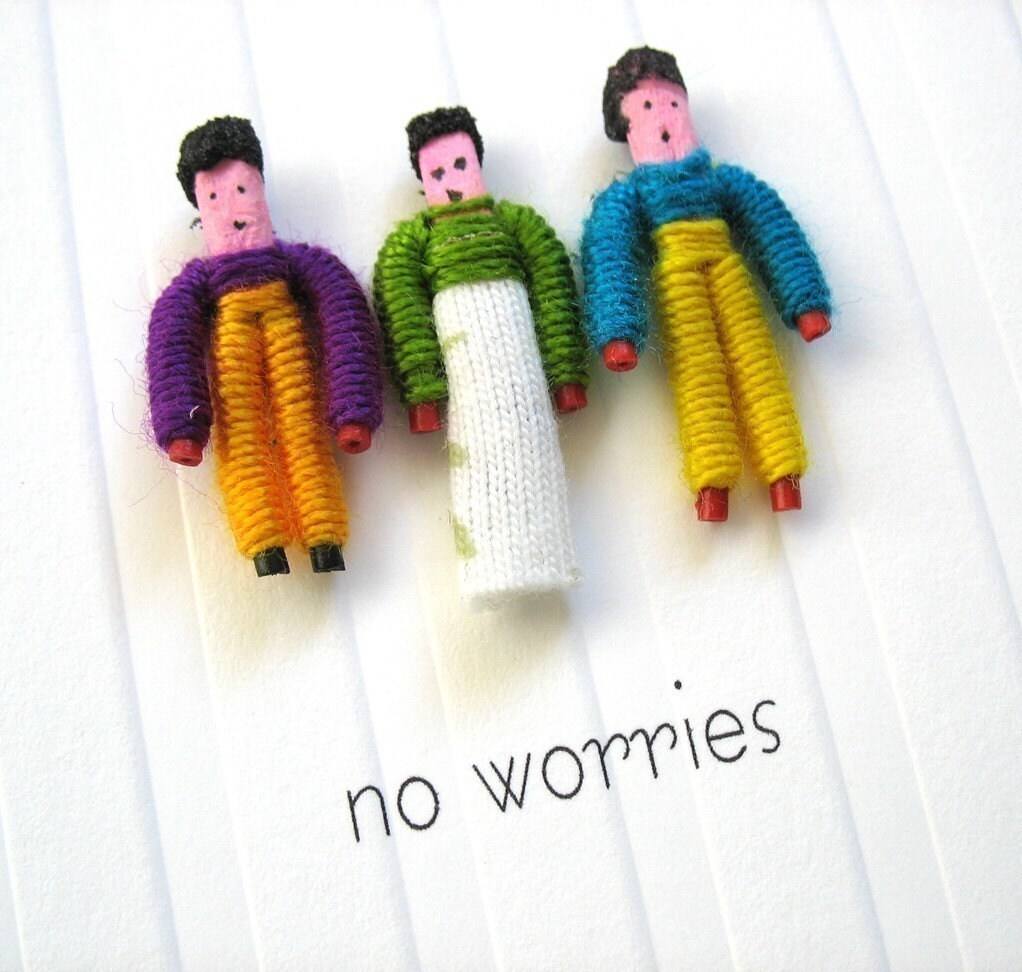
Worry Doll


For the past few weeks -- ever since Simon's last seizure -- Simon has been vomiting on a pretty regular basis. Totally out of the blue. One moment he is just standing there, the next he's got a pool of.. well, you know what.. at his feet. Even the babysitter (bless her!) has learned how to catch it bare-handed.

At first, we thought that this come-uppence was due to the increase in medication (it is a documented side effect). But, after 3 weeks, we weren't so sure and neither were Simon's doctors. Last week we visited the neurologist and she threw out a lot of (scary) ideas. Metabolic disorders and shunt malfunctions were at the top of the list.

So, we got tests done and the doctors conferred and we waited. I worried. Actually, I had a total meltdown. For an entire evening I was completely non-functional. I hadn't told anyone about my worries, or about what was going on, and I think I imploded a little.

I suspect that all people are, on some level, superstitious. Not necessarily walking around with talismans and incantations -- but maybe just holding back, guarding thoughts and speech against jinxes. Whispering our fears to imaginary "worry dolls" and setting them aside, leaving them underneath our pillows to turn over quietly in our hearts, in the dark.

If we don't talk about something, it won't be.

Unfortunately, the denial/talisman tactic didn't made me feel any better. I certainly wasn't sleeping better at night, and it didn't prevent my meltdown last week.

What helped was venting, and having a good cry. Learning more, through online research and emailing doctors with lots of questions. I can't say I have eliminated the worry, but I have deflated the balloon of anxiety a bit. Which is a good thing, because, although Simon has not vomited all week (the babysitter is especially relieved), his blood tests came back with abnormal results, and so we need to get more tests done. I know that no matter what I am feeling -- if Simon needs something -- whether it is more tests, or (yikes, I am going to say it out loud) surgery, to correct or repair his shunt, I have to be together. I have to be his talisman against the scary, and the painful, and the unknown. Worry dolls don't cry.

Wednesday, July 13, 2011

Get Away

There's nothing quite like packing for a beach trip with the kids to make me long for simpler days. Days when going to the beach meant throwing a bikini, a toothbrush, and a sundress into a cute little bag and dashing off to lie on the sand, work on my tan, and listen to the waves; occasionally breaking routine by reading a novel or going out dancing.

Sigh.

However, despite having to literally pack everything including the potty seat; I was looking forward to our trip to the beach last week. A change of scenery, time with family, and a chance to break a bit with reality -- namely work, chores, and therapy appointments five times a week. I even imagined that I would be able to mentally relax, simply enjoy the kids, and take a time off from worrying so much about Simon's present and future.

And, it was nice to get away. I needed that whiff of sea air, and I think the kids did, too. It was great to see our big, boisterous family, and I did manage to get a tan. But, my fears followed me to the shore. In truth, I was forced to face some things I'd been dreading wholeheartedly.

One thing I was prepared for. One my nephews is only a few months older than Simon, and watching Olivia play with him in a way so different from the way she interacts with Simon hurt my heart a little, dredging up unwanted "what would life be like if the stroke had never happened...?" thoughts. But, I had known this was coming -- and I was more prepared this time than I have been in the past. I let the thoughts come, and go. I checked myself when making comparisons, reminded myself to be positive. It was a little tough when the five year old cousin started asking questions about Simon's age and ability (and was in complete disbelief when I revealed that he and Simon were both 5); but, no harm meant or done. Simon is doing well, I remembered, he's okay.

Until he wasn't okay. Monday night, after a day full of parades, swimming, parties, and fireworks; Simon fell asleep in his car seat while we were stuck in traffic on the way back to the beach house. Sitting in the front passenger seat I found myself dozing off as well, until I was woken with a jolt by a horribly familiar rhythmic gurgling noise. The last time I'd heard that noise was November -- it was that strange sound that had alerted me to Simon's first seizure, the one that had lasted 2 hours and ended up with him unconscious in the PICU for days. I whipped around in my seat to see my fear confirmed -- Simon was having another seizure.

Though I was completely terrified on the inside, and I know Brian was too, we were -- to our credit (I think); completely calm outwardly. Brian pulled over and started to watch the clock (we've been told to administer Diastat if the seizure lasts more than five minutes), while I climbed into the back seat to unstrap Simon and lean him over so he wouldn't aspirate if he vomited (which he did). I looked into Simon's wide-open, vacant eyes and spoke softly to him, and to Olivia (who was freaking out). I told them what I didn't really believe -- that everything was alright. Then, just as we were getting ready to give Simon the medication and head to the hospital, he stopped. His blank eyes suddenly met mine, and he recognized me. He took a drink of water, and went right back to sleep. We took a collective deep breath. Brian merged back into traffic, and I sat in the backseat all the way home; holding Simon in one arm, and Olivia in the other. No one spoke.

I dialed the Neurologist on call when we got back. She told me not to worry. Kids with epilepsy are going to have seizures and not all of them are a big deal. They increased Simon's medicine a little since he has grown a bit, and they told me to call them if anything else happened. We have an appointment later this month.

So, all is well that ends well. We enjoyed the rest of the trip; swimming, biking, shopping, and playing in the sand. The kids had a blast with their cousins. I did get a great tan.

But, I didn't get away from my fear, I was forced to face it. I didn't get away from worrying about Simon -- especially with the increase in Keppra, which makes his mood swings volatile, something both hard to watch and to mitigate. Instead being relaxed, I was edgy. I had moments where I simply had a hard time keeping it together.

It has been a week since that episode, and I'm coping better. Coming home felt good, safe. I've tried to remind myself to be positive, and strong, and recognize the fact that the medication and the seizures are just a part of our life, they are our normal and I have to accept that. But I also recognize that there is a part of me that doesn't WANT to accept it. I don't want this for Simon. There is still a part of me that longs for a simpler time, and I may always wonder what life would be like without the stroke.

Tuesday, December 28, 2010

Day 1: Nothin' But Net


Today was a getting-to-know you and filling-out-forms sort of day. We went over Simon's medical and educational history about four or five times, and met the folks who will primarily be working with him - an OT, a PT, a Speech Pathologist, and a Nurse. Everyone seems really great. Very professional, pleasant, and patient with a little guy who was not on his best game today. We had at least four melt downs during the 2 hour evaluation, and no, they weren't because he lost at basketball.. or because he got his hands tangled in the net (oops...).

Behaviorally, we've been having some issues for the past six weeks, since Simon had the "status epilepticus" seizure (for about 2 hours) that necessitated his hospital stay, and the subsequent seizures that diagnosed epilepsy. The best drug to treat him with is Kepra, it is the safest and most effective medicine, and with it he hasn't had any seizure activity -- something we are truly grateful for, since it is nothing short of a miracle that Simon is still with us after what his little body went through. To be honest, we're terrified of a recurrence. The best analogy I have is that it feels like living on a fault line AFTER already having been through "The Big One." If I could move back to stable ground I would, but we can't, so bring on the seismic loading!

The fact that the Kepra is working is wonderful. The side effects are not. Because of the way the drug is metabolized, it causes a drop in serotonin, a "feel good" chemical in the brain. In adults, this causes depression. In kids, it causes increased irritability and defiant behavior... So, our once easy-going little guy now has a hairline trigger for full-on meltdowns. The first one he had after his release from the hospital was so terrifyingly intense I packed him into the car and took him to the pediatrician; I was convinced something was horribly wrong. We've been told that this may get better. We have seen some improvement, and it has also been suggested that enough B6 could help, so, I've ordered some (will let you know how that works!). In the meantime, we're working on helping Simon cope with his frustration and find ways to express himself without, well, screaming at us.

Anyone with a toddler knows about tantrums. They really do boil down to the child's ability (or inability) to communicate and feel understood under stress. The best tactic I've found (in case you need one), is to get on eye-level with the little maniac and use the simplest emphatic language possible to identify their emotion. For example: "Simon is MAD, Simon is SO MAD." After a while, they get that what they are feeling is called MAD and that you get that they are REALLY MAD. Then, they feel a little better. That's when you start with, "But you are OKAY. You can CALM DOWN. Let's take a DEEP BREATH." and  you demonstrate said breathing technique until  you are both in a better place. [For more on techniques like this check out "Happiest Toddler on the Block" by Dr. Harvey Karp. I found it pretty helpful (if a little silly in parts)]

For a kid with a communication disability this is really, really hard, but it was working! We'd been tantrum-free for months and when Simon got upset he would tell us how he felt, say that he "wanted to calm down" and started deep breaths on his own. Now, add the chemical imbalance and this has become damn near impossible. Tomorrow, add the casting and I'm talking about mommy going through a lot of wine...

(Sigh.)

Well, two steps forward and three (or four) back is how parenting sometimes goes, even under the best circumstances. Here's toasting a giant step forward into the unknown. Until tomorrow (the big casting day!).. thanks for coming with!